Heavy Equipment Movers

Crane and HIAB lifts

Crane and HIAB lifts for machinery in the UK: planned lifts onto mezzanines, over walls and onto roofs, with a lift plan under LOLER and BS 7121.

In short: Crane and HIAB lifts use a lorry-mounted crane or a mobile crane to load, unload or lift heavy equipment over obstacles, onto mezzanines or onto roofs. They suit any machinery move where items cannot be skated or forklifted into place. A HIAB lorry with operator typically costs £500 to £1,000 per day in the UK, and a contract crane lift often starts around £1,000 to £3,000.

Get a free quote

Fixed price, no obligation. We aim to reply the same day.

By sending this form you agree to be contacted about your enquiry. See our privacy policy.

Crane and HIAB lifts

A HIAB, or lorry loader, is a crane mounted on a flatbed lorry. It can load and unload its own cargo and lift moderate loads a short distance from the vehicle, which makes it ideal for delivering machines to industrial units, setting generators on plinths or lifting equipment over a low wall. Its capacity falls quickly as the boom extends, so the reach needed matters as much as the weight of the load.

For heavier loads, longer reaches or lifts onto roofs and upper floors, a mobile crane is used. Every lift in the UK must be planned by a competent person, appropriately supervised and carried out safely under LOLER. For crane lifts, that planning usually takes the form of a written lift plan following BS 7121, covering the crane, its position and outrigger loads, the rigging, ground conditions, exclusion zones and who is in charge on the day.

What is included

  • Assessment of load weight, centre of gravity and lifting points
  • Choice of HIAB or mobile crane based on weight and radius
  • Written lift plan and risk assessment before the lift day
  • Check of ground conditions and outrigger positions
  • Slings, shackles, spreader beams and lifting accessories with current thorough examinations
  • Exclusion zones and traffic management where the lift affects a road or yard
  • Supervision on the day by a competent lift supervisor
  • Help arranging any council permission needed to work from the highway

Who it is for

  • Loading and unloading machines at sites without a forklift
  • Lifting equipment onto mezzanines, upper floors or roofs
  • Setting generators, chillers or HVAC units onto plinths
  • Lifting machines over walls, fences or other obstructions
  • Delivering heavy items to sites with soft or uneven yards

How much does it cost?

As a guide, a HIAB lorry with operator typically costs £500 to £1,000 per day, and a contract crane lift with lift plan often starts around £1,000 to £3,000, rising for larger cranes, road closures or out-of-hours work. See our full cost guide.
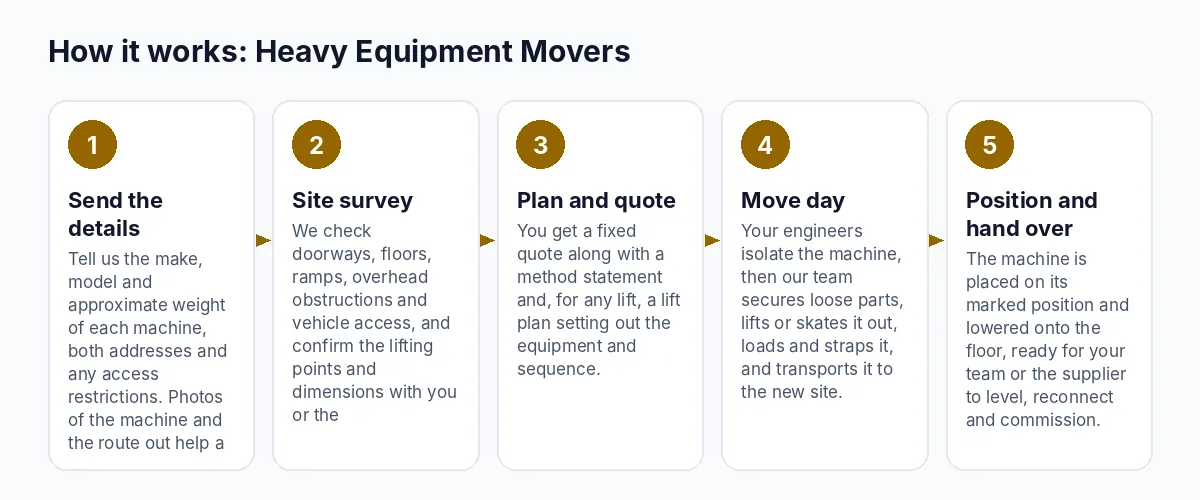
How it works

How crane and hiab lifts works, step by step
  1. Define the lift

    We confirm the load, its lifting points, where it is lifted from and where it needs to land, then calculate the radius and capacity required.

  2. Survey the ground

    The crane position is checked for ground bearing capacity, underground services, overhead lines and space for outriggers, with mats or spreader pads specified where needed.

  3. Write the lift plan

    The lift plan sets out the crane, rigging, sequence, exclusion zone and roles, and any road or pavement permissions are applied for in good time.

  4. Lift and land

    On the day the area is cleared, the load is rigged and test-lifted just off the ground, then lifted and landed under the direction of the supervisor.

Crane and HIAB lifts: FAQs

Should I choose a HIAB or a mobile crane?

A HIAB is usually the cheaper choice when the load is within its capacity at the reach needed and the lorry can park close to the lift point. A mobile crane is needed when the load is heavier, the reach is longer, or the lift is high, such as onto a roof. The capacity chart at the required radius decides it, so we check this on the survey.

Do I need permission to lift from the road?

If the crane or HIAB has to stand on the public highway or pavement, or the load swings over it, you will normally need permission from the local highway authority, and sometimes a road or pavement closure with traffic management. Lead times vary by council, from a few days to several weeks, so this needs raising early.

What is the difference between a contract lift and crane hire?

Under a contract lift, the lifting company plans, supervises and carries out the whole lift and takes responsibility for it. Under crane hire with an operator, you as the hirer are responsible for planning and supervising the lift and must provide a competent appointed person. Most businesses without lifting expertise are better served by a contract lift.

What happens if the weather is bad?

Cranes have wind speed limits that depend on the crane and the size of the load, since large flat loads catch the wind. The lift plan sets the limit, and the supervisor monitors conditions on the day. If wind or poor visibility makes the lift unsafe, it is paused or rescheduled, so it helps to have a back-up date in mind.

Get a quote for crane and hiab lifts

Send a few details and get one clear, fixed price, usually the same day.

Get a quote

Last updated 6 November 2026